A step-by-step guide to launching a lawn care business on monthly plans instead of per-visit invoices, from pricing and equipment to recurring payments and your first customers.
Key takeaways
- Bill lawn care monthly with automatic card payments for steady cash flow, less admin, and customers who stay.
- Form an LLC and get liability insurance before your first job so one accident can't reach your savings or home.
- Charge one flat monthly price for recurring work, set clear terms for weather and skipped visits, and sell extras as add-ons.
To start a lawn care business that bills monthly, choose a tight list of services, price them as flat monthly plans by lawn size, set up recurring card payments before your first job, and sell those plans door to door and through local listings.
Operating as a solo business? You can get started from about $1,600 with a used mower, trimmer, blower, plus insurance and an LLC. Billing monthly makes that initial investment worth it – you get predictable cash flow and never have to chase an invoice.
Ready to learn how to start your lawn care business? Keep reading. But first, here's why monthly billing beats charging per visit.
Why bill monthly instead of per visit?
Why not? Grass keeps growing, meaning it keeps needing to be cut. Putting it on a regular schedule, and billing for it the same way, makes sense for you and your customers.
People are already used to paying monthly. Their phone, streaming, gym membership, even their house cleaner all come out of their account automatically. Adding lawn care to that list means one less thing for them to think about. It just gets done.
For you, monthly billing means:
- Predictable revenue: You know what's coming in each month.
- Easier route planning: You can build a tight, efficient route instead of managing one-off bookings.
- Fewer late payments: Cards are charged automatically.
- Higher customer lifetime value: A customer on a plan stays until they actively cancel, while a per-visit customer has to decide to book you again every single time.
Here’s how per-visit invoicing and monthly billing compare:
| Per-visit invoicing | Monthly plan | |
|---|---|---|
| Cash flow | Lumpy; drops in rainy or slow weeks | Steady; the same amount lands every month |
| Admin time | An invoice for every visit, plus follow-ups on late ones | Set up once, then charged automatically |
| Churn | Every visit is a new decision to book (or not) | Customers stay on until they cancel |
| Pricing power | Easy for customers to compare your per-mow price against competitors | A bundled plan is about the outcome (a lawn that always looks good), not the price of one cut |
Imagine that you've got 40 customers who each pay $150 a month. That's $6,000 in monthly revenue.
With per-visit billing, every skipped mow is a skipped payment, whether it’s because of rain, a customer’s vacation, or grass that’s barely growing in a dry spell. And you're also chasing 40 customers a month to book each visit, then chasing them for a payment afterward. That's a lot of admin.
On a monthly plan, those same customers are on a fixed schedule and are charged automatically, so there's nothing to chase.
There's one small trade-off: flat monthly pricing only works when customers know exactly what they're paying for, so you'll need clear terms for what happens in poor weather, winter, and for skipped visits. I'll cover this in Step 3.
Setting up your lawn care business for recurring revenue
Here's how to set up your lawn care business, from what you should buy to how you can scale.
Step 1: Decide your setup and get equipped
Part time or full time?
Before you buy anything, decide how much time you want to put into this business. If you're a part-time solopreneur mowing lawns as a weekend side hustle then you don't need to blow the budget on commercial-grade equipment – residential-grade will do just fine.
But if you're going all-in on a lawn care business, you'll need a professional kit to manage your workload.
| Part-time (evenings and weekends) | Full-time solo | |
|---|---|---|
| Hours per week | 15–20 | 40+ |
| Kit level | Push mower, trimmer, and blower; hauled in your own SUV or truck | Zero-turn mower (used or new), pro-grade trimmer and blower, plus a trailer |
| Realistic customer count | About 15–25 weekly lawns | About 35–50 weekly lawns |
| Startup cost | About $1,600–$4,800 | About $5,600–$15,300 |
Startup costs include equipment, fuel cans, safety gear, a year of general liability insurance, and LLC filing fees, but not a vehicle. The full-time range runs from a used zero-turn and used trailer to a new entry-level commercial mower and new trailer; larger or premium commercial mowers can cost $15,000 or more on their own.
You'll also need to decide who you're mowing for. Homeowners are quick to sign up and suit simple monthly plans, but you're taking on several small jobs a month.
Commercial clients like HOAs and property managers bring in much bigger work as they can give you several properties in one contract, but they expect custom quotes, formal contracts, and proof of insurance.
Most solo operators start with residential services and move into commercial work later (I'll cover this in Step 6).
Equipment and startup costs
You don't need a garage full of gear to get started. At a minimum, you need something to cut grass, something to tidy the edges, something to clean up after yourself, and a way to move the equipment between lawns.
| Equipment | Budget option | Pro-grade option |
|---|---|---|
| Push mower | Toro 21" Recycler: $389 | Toro 21" Heavy-Duty Recycler: $1,699–$2,149 |
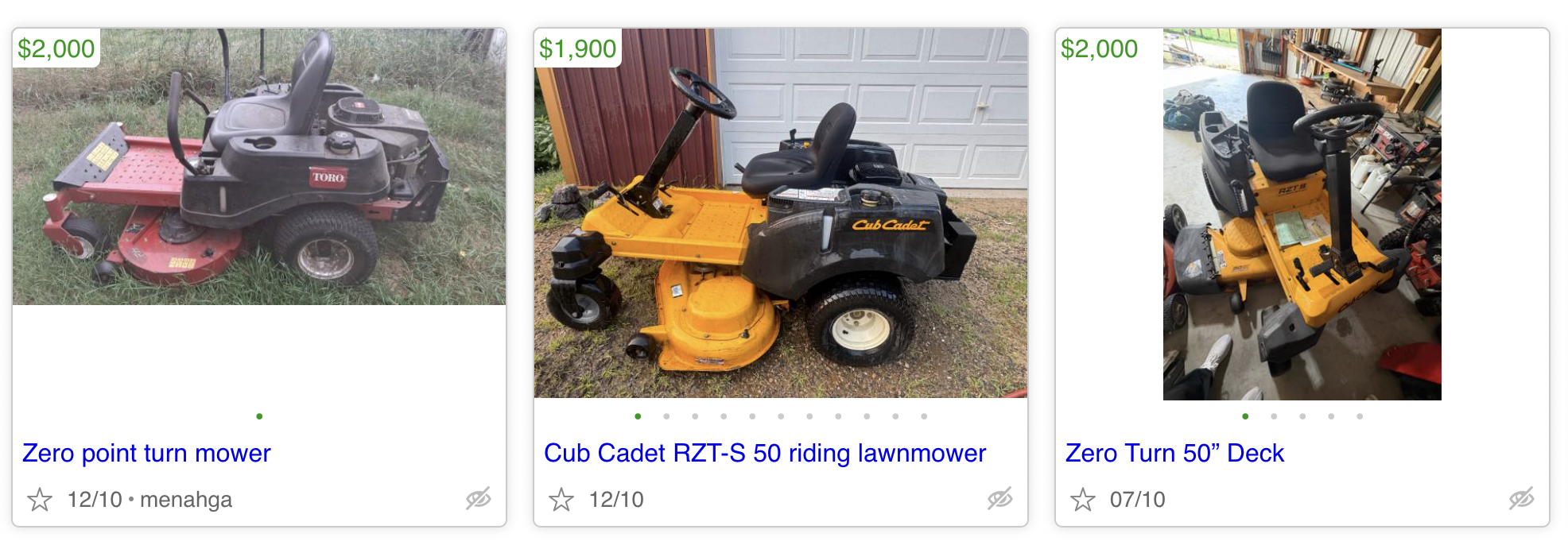
| Zero-turn mower | Used 48" zero-turn: $1,600–$5,000 | Kioti ZXC48 LT: $10,299 |
| String trimmer | Echo SRM-225: $230 | Stihl FS 91 R: $370 |
| Blower | Echo PB-2520 handheld: $200 | Stihl BR 600 backpack: $550 |
| Edger | Use your string trimmer: $0 | Echo PE-2620: $400 |
| Trailer | Used 6x12 utility: $1,100–$1,750 | Carry-On 6x12 landscape: $2,400 |
| Fuel cans (x2) | Midwest + Scepter 5-gallon: ~$52 | No-Spill 5-gallon + 2.5-gallon: ~$79 |
| Safety gear | 3M Virtua glasses + Peltor X4A earmuffs: ~$45 | 3M SecureFit anti-fog glasses + Peltor X4A earmuffs: ~$50 |
Manufacturer and dealer prices, checked October 2026.
Remember, you don't have to buy everything new on day one. A used 48" zero-turn costs just a fraction of a new one, and if it's a dealer trade-in, it usually has only a few hundred hours on the clock.
For equipment you'll use only a few times a season – like aerators or dethatchers – rent until you can justify buying. And if you want a new commercial mower without a big upfront bill, some dealers offer leases for a fixed monthly payment.
Once you're up and running, you'll need to budget for fuel for your mower, handheld tools, air filters, and sharpening or replacing mower blades, plus your insurance. You’ll also pay a small fee on each payment you accept, and possibly a subscription for any scheduling or route-planning app you use.
Step 2: Get legal and insured
You’ve got the equipment, now it’s time to get legal and insured. It’s the boring part of running a business, but it protects you if something goes wrong.
Requirements vary by state and city, so treat this as a checklist and confirm the details locally:
| What you need | When | Why | Typical cost |
|---|---|---|---|
| LLC | Before you start | Separates personal and business finances | $35–$500 to file (most states $50–$200) |
| Local business license | Before you start | Required by most cities or counties | Varies; usually low |
| General liability insurance | Before your first job | Covers damage or injuries you cause | ~$57/month |
| Commercial auto insurance | If you haul gear in a work vehicle | Personal policies may not cover work use | ~$255/month |
| Tools and equipment insurance | Before your first job (recommended) | Covers stolen, lost, or damaged gear | ~$42/month |
| Workers’ compensation | Once you hire help | Covers employees injured on the job | ~$123/month |
Insurance costs are Insureon averages for lawn care businesses.
If you only sort out a few things before your first job, make it these.
- First, form an LLC. As a sole proprietor, your business and personal finances are legally the same, so a lawsuit or business debt can reach your savings, car, and even your home. An LLC puts a legal wall between the two, as long as you keep your business and personal money separate. It won’t cover you for your own mistakes on the job, though, which is where insurance comes in.
- Next, get general liability insurance, because sooner or later a rock is going to fly out from under your mower and through someone's window. This is the policy that pays for it, and many HOAs and commercial clients won't hire you without it.
- Then protect your gear with tools and equipment insurance. Your mower, trimmer, and blower are the business, and if they're stolen off your trailer, you can't work until you replace them. This coverage pays to replace them so a break-in doesn't cost you weeks of income.
- Workers' compensation can wait until you hire your first helper, but budget for it early so it doesn't catch you off guard when you scale (more on that in Step 6).
- Sales tax: Some states charge sales tax on lawn care services, while others don’t. Check your state’s department of revenue so you know whether to add tax to your monthly plan price.
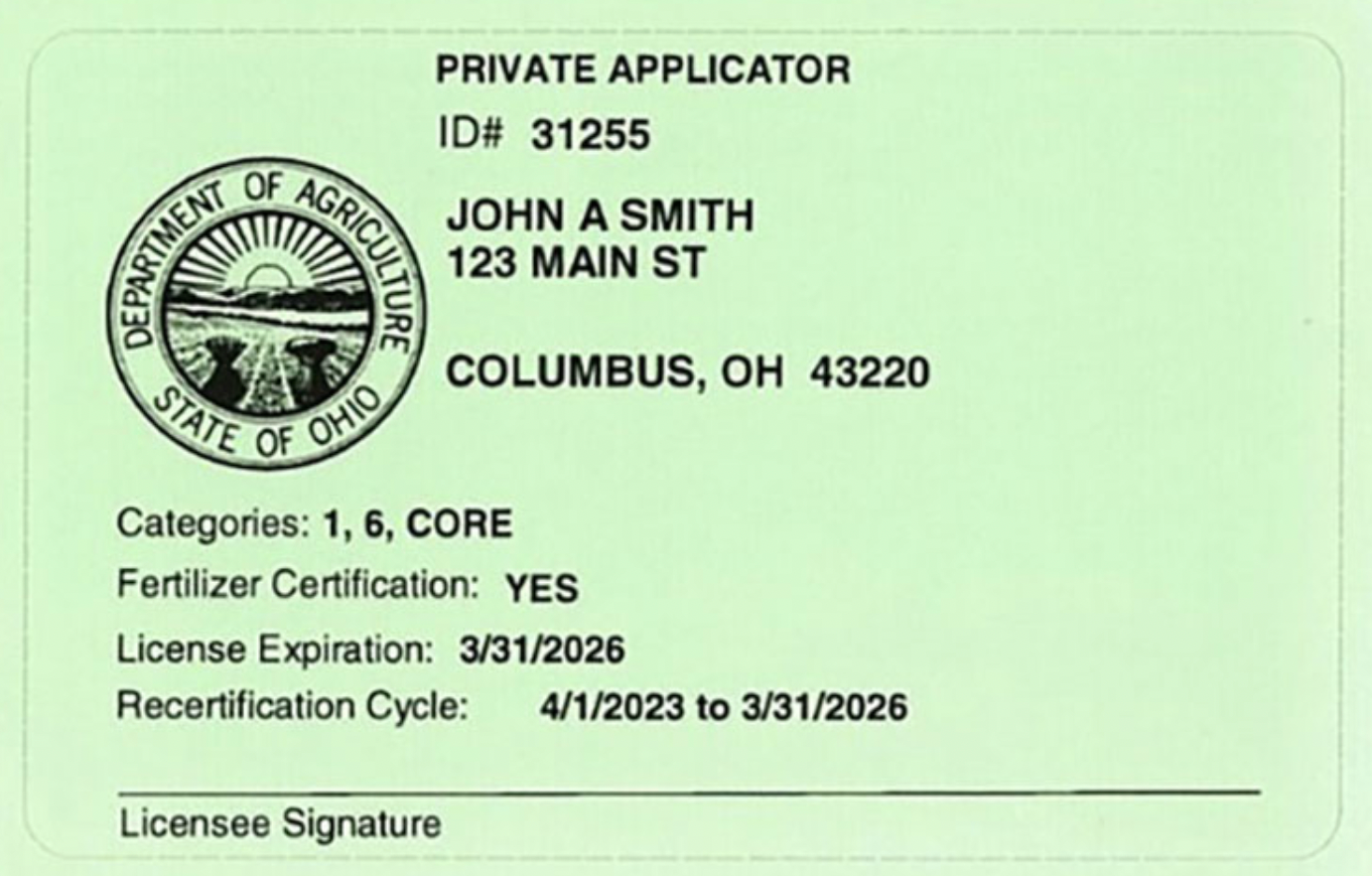
And if you use pesticides, you'll need a pesticide applicator license. You only need this if you offer chemical treatments like fertilizer with weed control or pest control. Under federal rules, anyone who applies or supervises the use of restricted use pesticides must be certified as a private or commercial applicator.
A lot of states go further and require applicator certification to use all pesticides commercially, whether or not they are restricted use, so check with your state’s pesticide regulatory agency before adding treatments to your plans.
I cannot stress enough how important it is to get these in place before you start. In Ohio, one rock thrown by a mower at a state park caused serious injury to Richard Combs' eye, and led to a lawsuit that went all the way to the state Supreme Court and settled for $70,000.
That's an extreme example, but it shows you just how serious this could be. And if you're using pesticide without a license, you could be fined up to $2,500 per violation in Colorado.
TL;DR: Treat your lawn care business like a real business from day one.
Step 3: Build your monthly plans
Choose your services
Your monthly plan should cover the jobs that every customer needs on repeat – things like mowing, edging, trimming, and blowing, plus seasonal cleanups and fertilization programs. You can bill these as one flat monthly price, because you know that you'll be repeating them regularly.
For everything else, bill individually as an add-on. That includes seasonal extras like aeration, leaf removal, hedge trimming, and mulching, as well as larger one-off jobs like landscaping installs or laying sod.
If you find yourself taking on more repairs and odd jobs, check out our guide to starting a handyman business.
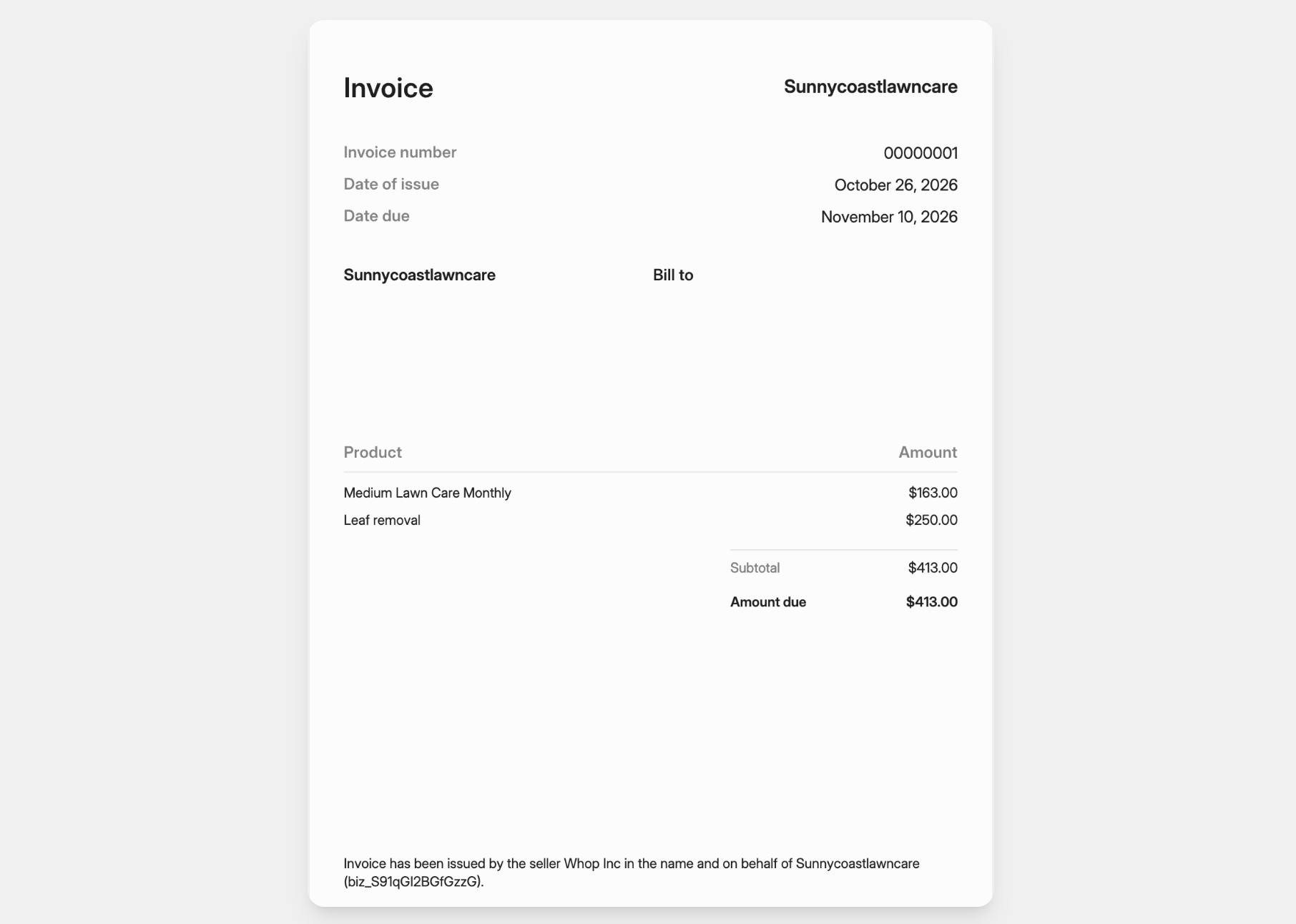
Your monthly price stays simple, but customers can upgrade with these add-ons and increase your customer lifetime value over time.
How often you visit your clients depends on the grass in your area. According to the University of California's Integrated Pest Management Program, cool-season grasses are most active during the spring and fall, while warm-season grasses are most active during the summer months.
What does that mean for you? Weekly visits during your local peak growing season, and fewer visits when growth slows down. But your monthly price stays the same either way, which I'll explain below.
Here’s a simple three-tier setup to start with:
| Plan | What’s included | Visit frequency |
|---|---|---|
| Basic | Mowing and edging | Weekly in peak growing season, every two weeks when growth slows |
| Standard | Mowing, edging, trimming, and blowing, plus spring and fall cleanups | Weekly in peak growing season, every two weeks when growth slows |
| Premium | Everything in Standard, plus fertilization and weed control* | Weekly in peak growing season, every two weeks when growth slows, plus scheduled treatment visits |
*Requires a pesticide applicator license in many states (see Step 2).
Price your monthly plans
To figure out your flat monthly price, work out what each lawn costs you per visit, then spread it evenly across the year.
Of course, there's more to it than that. You need to factor in overheads like drive time, fuel, and equipment, and adjust for the size of the lawn. Here's how:
- Start with lawn size. Calculate how long it would take to work on a small (up to 1/4 acre), medium (1/4-1/2 acre), and large (1/2-1 acre) lawn. Most homeowners fit into one of these brackets; for anything over 1 acre, charge custom pricing. To check you’re in the right ballpark, LawnStarter’s mowing cost data, based on jobs booked through its platform, puts typical per-visit prices at $41-$61 for lawns up to a quarter acre, $49-$69 for a quarter to half an acre, and $59-$114 for half an acre to an acre. Prices vary a lot by region, so check what local competitors charge too.
- Add in drive time. Work out the area you’ll service and how long it takes, on average, to drive to a job there. Add that time to each lawn size.
- Add a few dollars per visit to cover fuel and equipment wear, scaled to the size of the job.
Now you have three per-visit prices for small, medium, and large lawns. For each of these three, multiply the price by the number of visits you expect to make across the year, and divide by 12.
Here’s how that works for three lawn sizes, assuming a target rate of $60 an hour and about 30 visits a year:
| Small (up to ¼ acre) | Medium (¼–½ acre) | Large (½–1 acre) | |
|---|---|---|---|
| Time per visit (incl. travel) | 45 minutes | 1 hour | 1.5 hours |
| Labor at $60/hour | $45 | $60 | $90 |
| Fuel and wear | $5 | $5 | $8 |
| Price per visit | $50 | $65 | $98 |
| Annual price (30 visits) | $1,500 | $1,950 | $2,940 |
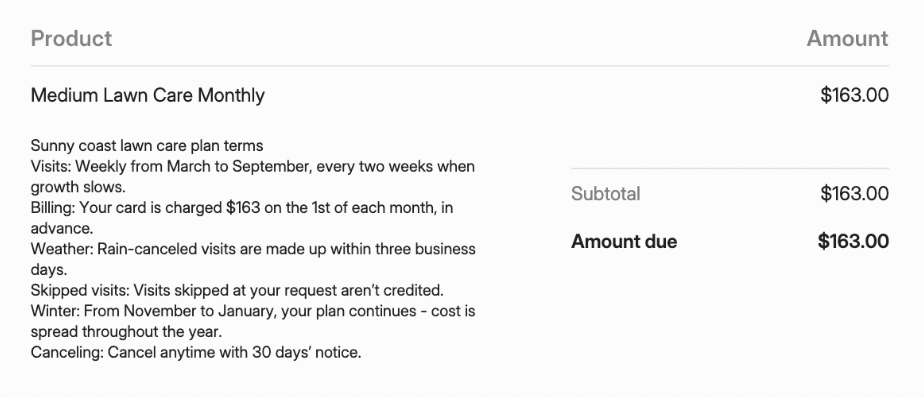
| Monthly price (÷ 12) | $125 | $163 | $245 |
You'll visit more often in peak growing season and less when growth slows, but your customer pays the same amount every month, and you get a steady income.
Make sure that customers understand this upfront, or they may wonder why they got four visits one month and one the next. Frame this recurring flat fee as a great way to spread their costs, too, so they're not spending more in growing season.
Set a minimum monthly price, and stick to it. Haggling at the door means customers will expect discounts, and even a lawn that takes 20 minutes still costs you the drive.
To lock in customers for the full season, offer a discount for paying a year upfront, such as one month free. You get cash upfront, and because annual plans are paid in advance, they have their own terms: no refunds for cancellations partway through the year.
Set your plan terms
A flat monthly price only works if customers know exactly what they’re paying for. Before you sign up anyone, set clear rules and put them on your checkout page and flyer so customers agree before they pay.
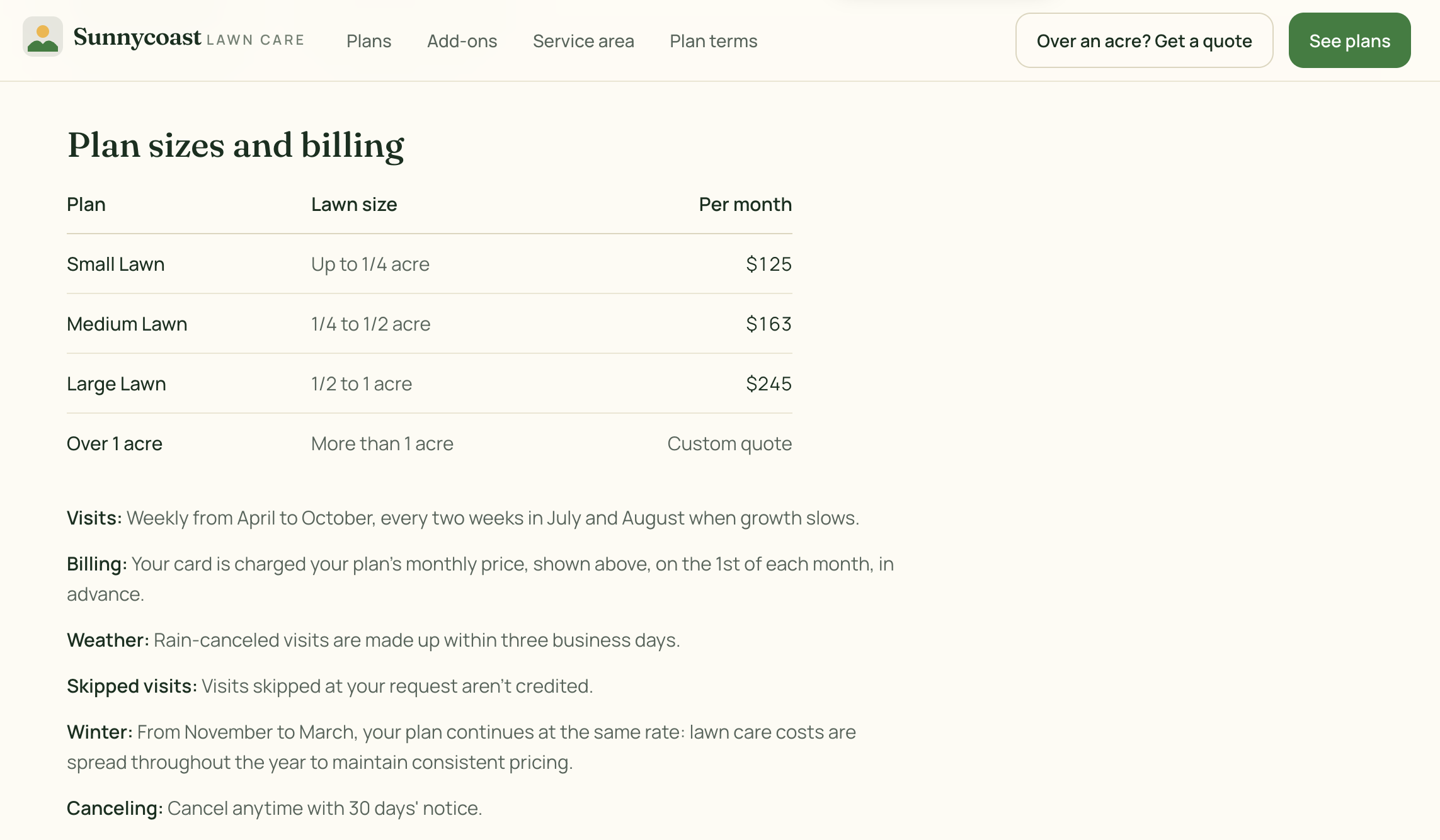
Bill in advance, on the 1st of each month for that month's service. That way you're not mowing on credit and chasing payment for services rendered.
Then decide how you’ll handle winter. The pricing example above divides your annual price by 12, so customers pay the same all year, including the months you’re not mowing. If that’s a hard sell in your area, you can pause plans over winter instead. Just divide your annual price by the number of months you’ll actually bill.
For example, if you bill for nine months, the medium lawn becomes $1,950 ÷ 9 = about $217 a month. Or, you can charge a small reduced rate in winter and spread the rest across the growing season, so your annual total stays the same.
There’s one catch with averaged pricing: customers pay the same in winter as they do in peak season, so someone who cancels in the fall has had more visits than they’ve paid for.
Say a medium-lawn customer joins in April and cancels in October. By then, they’ve had about 27 visits, worth about $1,755 at $65 per visit, but they’ve only made seven payments of $163, or about $1,141.
You can close that gap in one of three ways:
- Set a minimum term: Ask customers to commit for a full season or year when they sign up.
- Add a true-up clause: For example, "If you cancel before [month], we charge the difference between the visits delivered and the payments made."
- Bill over the growing season only: Divide your annual price by nine months instead of 12, so each payment covers the visits in that month.
You’ll also need a rule for customers who join mid-month. The simplest option is to charge the first month at sign-up, then move them onto the 1st from the next month. Or you can prorate the first month, so they only pay for the days left.
And review your prices once a year, around tax time. Fuel, insurance, and equipment costs go up, so your prices should too – just give customers at least a month's notice before a price change.
Here’s a sample you can adapt:
[Your Business Name] plan terms
- Visits: Weekly from [month] to [month], every two weeks when growth slows.
- Billing: Your card is charged [$X] on the 1st of each month, in advance.
- Weather: Rain-canceled visits are made up within three business days.
- Skipped visits: Visits skipped at your request aren’t credited.
- Winter: From [month] to [month], your plan [continues / drops to $X / is paused].
- Canceling: Cancel anytime with 30 days’ notice.
Some states have automatic renewal laws for subscriptions, so check your local rules before you launch.
Step 4: Set up recurring payments before your first customer
What you need from a payment setup
Get your payment system set up before you start reaching out to customers. If a customer says yes on the doorstep, you want them signed up and paying right away, not waiting on an invoice.
Look for a service business payment setup that charges customers' cards automatically on the same date each month, and retries failed payments so you're not doing that manually.
Customers should also be able to upgrade their plan, book add-ons, or update their card details themselves, without contacting you. And money should land in your bank account without you having to manually withdraw.
Getting your payment setup right is what makes monthly billing work. Get this wrong and you're still chasing invoices after hours.
I set up all of this on Whop, including monthly plans, automatic billing, and checkout, in under 15 minutes. I’ll show you how, step by step, in the Whop and Grok Bot section below.
Step 5: Get your first customers
Knock on doors
Door knocking is the oldest sales trick in the book – and it still works. It's how Joe Kucik, owner of Scott's Lawn Service in Lansing, Michigan, got his first lawn care clients back in 1984. Speaking to Lawn & Landscape, Kucik says:
"Even after weeks of doing it, it was hard to knock on that first door every night. But I really believe you can take somebody who’s not afraid to go door knocking and they could grow a lawn care business in a year".
And it's how Shelby Haas broke into sales, selling pest control door to door. As our world becomes more online, don't neglect the power of face-to-face.
Your clients will be inviting you into their property to carry out a service, so it helps to build trust in person, and while a homeowner can scroll past an ad, it’s hard to forget the friendly person standing on their porch.
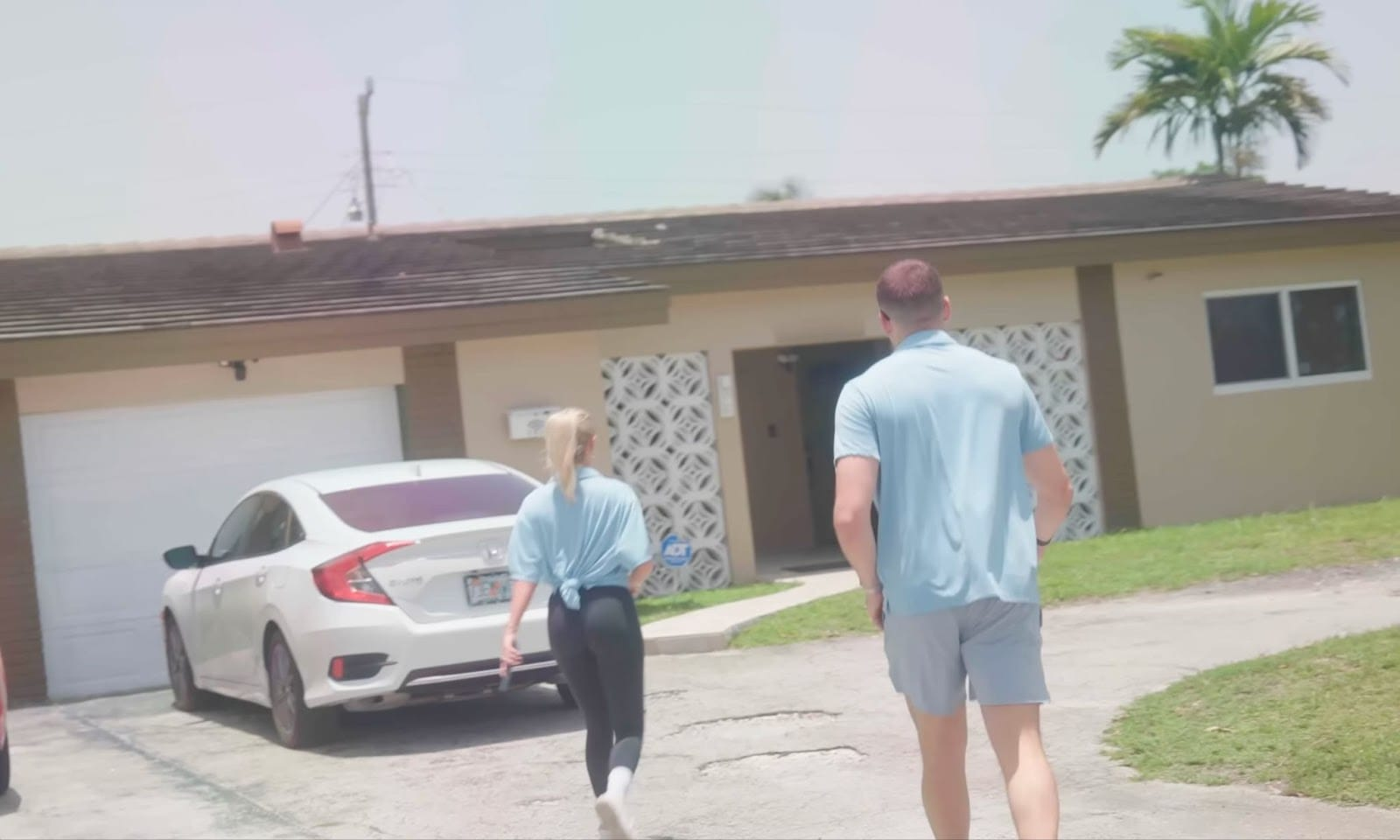
Start in one or two dense neighborhoods, ideally where you can see lawns that need attention. Don't show up empty-handed – bring a flyer that shows your service plans and a QR code that takes customers straight to checkout.
Keep your pitch short, and sell the plan, not a single lawn service. Shelby's approach works well here: give a reason for stopping by, then ask a question instead of launching into a speech. For example:
"Hi, I’m [name]. I’m setting up a weekly mowing route on this street, so I thought I’d stop by while the grass is really taking off. How has keeping up with it been going this year?"
If they're interested, explain that it's one flat monthly price, they never have to book or pay per visit, and they can sign up right now.
Emphasize that with your service, they get their time back – they don't have to care for the lawn, book online, remember to pay an invoice, or call you – it just gets done.
What to say when the customer says 'no'
A monthly plan is a new idea for a lot of homeowners, so expect a few questions. Have a one-line answer ready for each:
- I only need you when I call: That’s what this replaces: you never have to call, book, or remember. The lawn stays looking good, always.
- Why would I pay in winter? Because the price is averaged across the year, so you’re not paying more in peak season. Spring and summer cost the same as January. (If you pause plans in winter instead, say that.)
- My neighbor’s guy is $35 a cut: That’s just the mow. This plan includes edging, trimming, and blowing on a set schedule.
What to say when the customer says 'yes'
The sixty seconds after a yes are when you lock in the sale, so don’t leave with a "great, I’ll be in touch." Instead:
- Have them scan the QR code and sign up on the spot. Their first month is charged right there.
- Note their lawn size and any access details, like a gate code or whether the dog will be out.
- Agree on their first visit date, so they know when to expect you.
By the time you walk away, they’re a paying customer with a date locked in.
Make your work visible in person...
Every lawn you care for is an advertisement. Ask customers if you can put a small yard sign on their lawn, especially on corner lots that get the most traffic. Add magnetic signs to your vehicle so neighbors see your name every time you pull up.

And don't forget to take before-and-after photos of every new lawn – they're the best proof you have when you post online. Just make sure to ask for permission if there is anything identifiable in the images.
...And visible online
To get found online, set up a free Google Business Profile as soon as you launch, so that you can show up when locals search for 'lawn care near me'.
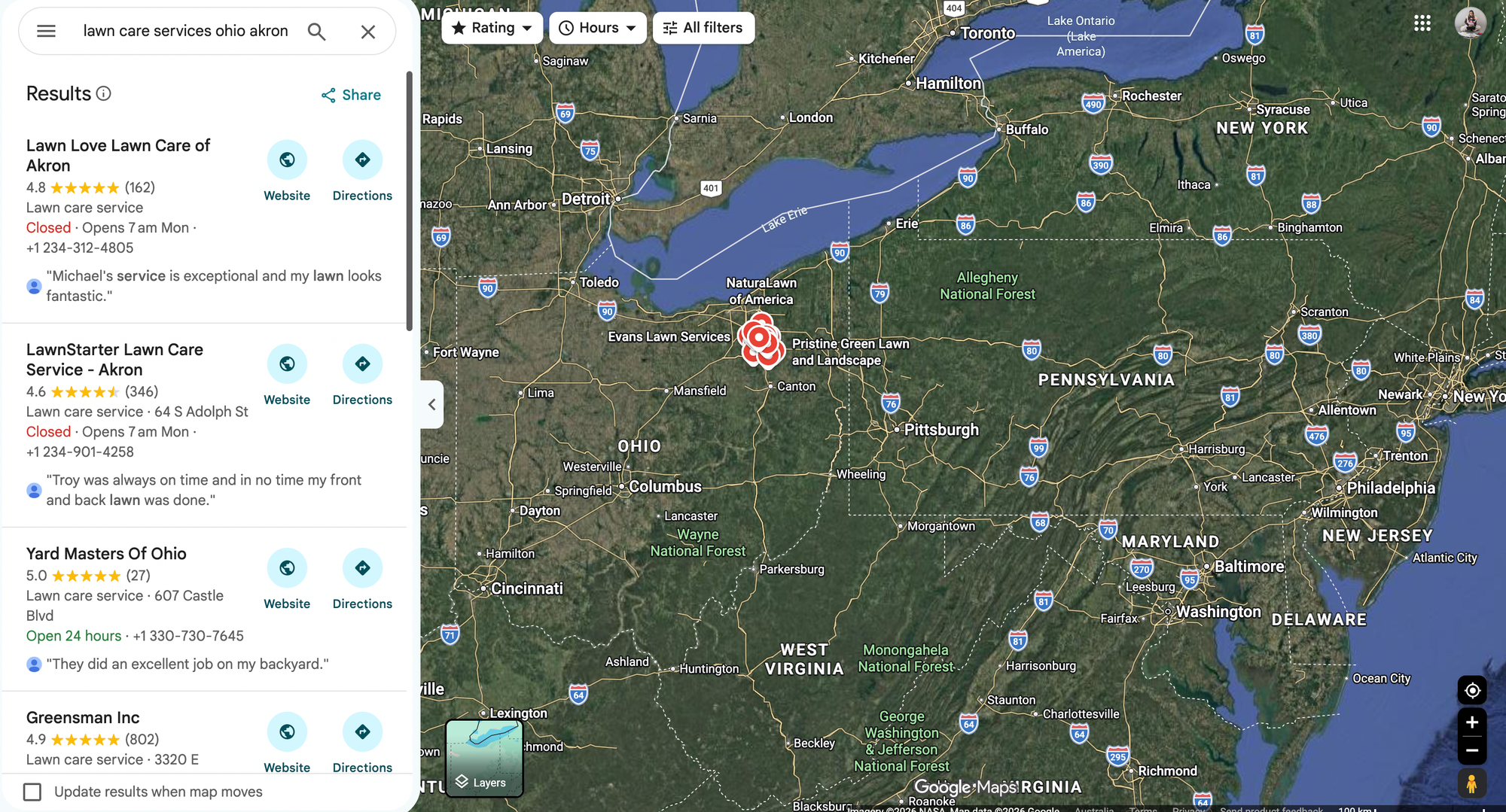
Ask your customers for a Google review. According to BrightLocal, 97% of consumers read reviews before choosing a local business, and nearly half won’t use one with fewer than 20 reviews, so make collecting them a habit from your very first lawn.
And don't underestimate the power of online community boards, like Facebook groups and Nextdoor. Neighbors regularly ask each other for service recommendations, and some groups allow you to advertise for a small fee.
Once you’ve got a few customers and some before-and-after photos, you can reach more homeowners with paid ads without leaving Whop.
Whop Ads provides the ad accounts, you (or Grok Bot) run the campaigns, and you fund them with a credit card or your Whop balance.
There are no setup fees, no monthly fees, and no minimum spend, so you can start small and reinvest what your monthly plans bring in.
Reward referrals
It should be pretty clear by now that word-of-mouth is your best marketing channel – your happiest customers are your best salespeople, so give them a reason to talk about you.
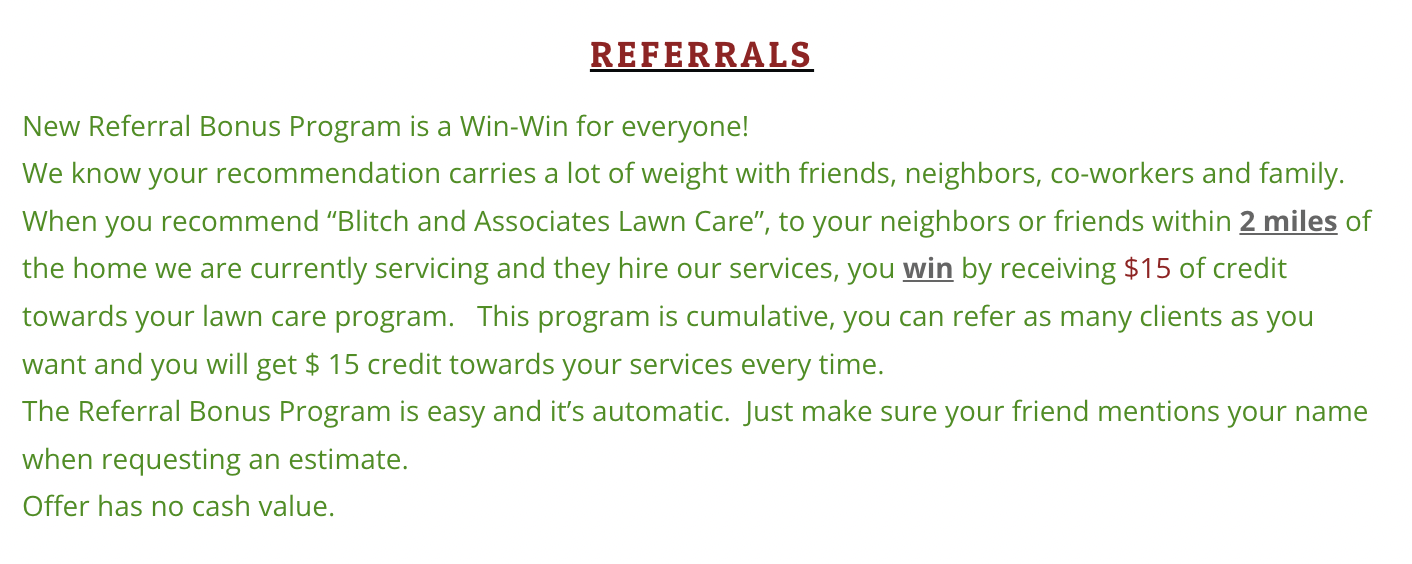
Blitch and Associates Lawn Care in Charlotte, North Carolina, gives customers credit toward their lawn care program when they refer neighbors or friends within 2 miles of a home they already service. More customers on the same route means less driving between jobs and more hours in the day to work – it's a win-win.
Partner with realtors, property managers, and HOAs
Realtors are a great source of new customers, because new homeowners need lawn care straight away. Offer to keep their listings looking sharp, and ask them to pass your details on to buyers.
Once you’ve built up a track record, property managers and HOAs can give you several lawns under a single contract.
Step 6: Run your route, keep customers, and scale
Run your route
The secret to a profitable lawn care business?
Route density. The closer together your customers are, the less time you spend driving, and the more lawns you can get through in a day. Cluster customers by street and neighborhood, and give each area its own day of the week.
Here's what a simple weekly schedule could look like for a full-time solo operator with 40 customers:
| Day | Area | Lawns |
|---|---|---|
| Monday | Oak Ridge | 10 |
| Tuesday | Maple Heights | 10 |
| Wednesday | Riverside | 10 |
| Thursday | Cedar Park | 10 |
| Friday | Make-up day for rain and missed visits, plus add-on jobs | Varies |
Keeping one day a week free is what makes your plan terms work. It gives you the flexibility to reschedule bookings that have been rained out, so you can deliver on your make-up promise without having to reschedule your whole calendar.
Make sure to keep your customers happy
Don't forget to focus on retaining your existing customers, not just attracting new ones. Send a quick before-and-after photo after each visit, so customers see what they're paying for, and as seasons change, give them a heads-up before winter terms kick in.
Keep a close eye on those cancellations, too. A few cancellations at the end of the season are normal, but if you're getting multiple cancellations mid-season, ask customers why they are leaving – and fix it before it costs you your whole route.
Scale from a solo route to a crew
This is where everything you've set up so far pays off. You'll know you're ready to make your first hire when you start turning down new customers, working after hours, or your equipment is struggling to keep up. For a full-time solo operator, that usually happens around 40-50 weekly lawns.
From there, your business's growth tends to happen in clear stages:
| Stage | What it looks like | Roughly when* |
|---|---|---|
| Solo | You, one mower, one route | Up to 40–50 lawns (~$6,000–$7,500/month) |
| Add a helper | Two people, two mowers: one mows while the other trims, edges, and blows | When you’re turning down work at 40–50 lawns |
| Add a second truck | Two crews running two routes, with a crew leader on the second | When both crew members’ days are full |
| Go commercial | Contracts with HOAs, property managers, and businesses, often covering several properties at once | Once you have the crew, equipment, and track record to win bids |
*Estimates based on about one lawn per working hour and $150 a month per customer.
Monthly billing makes each one of these scaling steps less risky. With per-visit billing, hiring someone is a gamble, because you're hoping that there will be enough work next month to pay them. By selling monthly plans instead, you know exactly how much is coming in on the 1st, so you can calculate whether you can afford a new hire before you take one on.
And because your customers are already booked ahead, a new crew member starts on a route that's already paid for.
When you do hire, be sure to budget for workers' compensation insurance, which Insureon reports costs lawn care businesses an average of about $123 a month. You’re also responsible for safety training: OSHA requires employers to conduct all required training in a language and vocabulary workers can understand. OSHA’s landscaping safety page has free training resources, including materials in Spanish.
Follow these six steps and you'll have your own lawn care business that bills monthly.
Here’s the easiest way to do all of this: a done-for-you build you can finish in an afternoon.
Build your lawn care business in an afternoon with Whop and Grok Bot
You’ve got the plan. Now here’s how to build it, fast.
I set up a complete lawn care business with Whop and Grok Bot in just a few hours. Whop builds your website, plans, and checkout. Grok Bot handles the research and admin.
Copy my prompts, and work through these steps in order. Each one builds on the last, so by the end you’ll have a live business with customers signing up.
You’ll need an eligible plan: SuperGrok Heavy, Cursor Ultra, or Cursor Teams Premium.
Connect Whop to Grok Bot
In Grok Bot, add the Whop connector and sign in to your Whop account.
You'll need a Whop account, free to create at whop.com. To connect:
- Go to grok.com/connectors
- Sign in if needed
- Click New Connector
- Select Whop from the list
- Authorize your Whop account
This lets Grok Bot see and manage your business, like your plans, customers, and payments, so you can run admin tasks with a single prompt instead of clicking through dashboards.
Once connected, just chat with Grok normally. It will use the connector automatically to pull data and take action inside the conversation.
Start with your business brief
Paste this into Grok Bot first. It saves your details as a file, so you can come back to any of these prompts later without retyping them.
Here’s my lawn care business brief:
- Business name: [X]
- Service area: [neighborhoods or ZIP codes], [city, state]
- Part-time or full-time: [X], about [number] lawns a week, mostly [small / medium / large] yards
- Mowing season: [month] to [month]
- Equipment budget: $[X]
- Target hourly rate: $[X]
- Time on site: [X] minutes for a small lawn, [X] for a medium lawn, [X] for a large lawn
- Average drive time between jobs: [X] minutes
- Monthly fixed costs (insurance, phone, software): $[X]
- Plans: Basic (mowing and edging), Standard (plus trimming, blowing, and spring and fall cleanups), Premium (plus fertilization and weed control)
- Winter billing: [same price all year / reduced rate / paused]
- Cancellation terms: [month-to-month with 30 days’ notice / season commitment / true-up clause]
- Phone and hours: [X]
Save this as a file called lawn-care-business-brief, and read it before every task I give you, including in future conversations.
Plan your business with Grok Bot
Before you build anything, let Grok Bot do the research. These five prompts give you your equipment list, local requirements, prices, and plan terms, which are everything you’ll need for your website in the next step.
Read my business brief file. Research current prices and build an Excel spreadsheet of the equipment I need, with columns for: item, budget option and price, pro-grade option and price, where to buy (with clickable links to local dealers, used listings, and manufacturer pages), and whether to buy new, buy used, rent, or skip for now.
Suit the list to my yard sizes and area, recommend used where it saves money, add a starter total at the bottom, and flag anything that pushes me over budget.
Read my business brief file. Search official government websites and list the licenses, registrations, and insurance I need, including whether my state taxes lawn care services and whether I need a pesticide applicator license for the Premium plan. Link to the official page for each requirement.
Always click through to the official pages to confirm. Rules change, and AI can get local details wrong.
An LLC isn’t legally required to run a lawn care business, but it protects your personal assets if the business is sued or runs up debt. If you’d like to set one up now, you can do it without leaving Whop.
Prefer to do it yourself? You can also register your LLC directly in Whop’s registration portal.
Read my business brief file. Help me form an LLC through my Whop business. Tell me what details I’ll need (business name, state, address, and business activity), check that my business name is available in my state, and fill in what you can from my brief. Stop before anything is submitted or paid so I can review it and confirm myself. Once it’s filed, add my LLC name and details to my business brief file.
Read my business brief file. Work out a flat monthly price for each plan and lawn size, assuming weekly visits in peak season and every two weeks when growth slows. Include fuel and equipment wear, my fixed costs, and payment fees of 2.7% + $0.30 per card payment [plus 0.5% for billing automation]. Then give me:
- Monthly prices billed 12 months a year, and billed only during my mowing season
- An annual prepay price with one month free
- A minimum monthly price
- How many customers I need to cover my costs and to hit $[X] a month
- What local lawn care companies charge, with links, and how my prices compare
Put it in a spreadsheet with formulas so I can change any input. If anything’s missing, ask me before you calculate. Then add my final prices to my business brief file.
Read my business brief file. Write plain-English plan terms for my monthly plans, covering visit frequency by season, billing on the 1st, a three-day rain make-up window, no credit for customer-requested skips, my winter billing, and my cancellation terms. Keep it to six or seven short lines a customer can read at checkout. Then add the terms to my business brief file.
Build your website and plans with Whop
This is where your business goes live. I built my entire lawn care website in under 15 minutes with a Whop Blueprint and a single prompt in Whop AI.
- Copy a Blueprint: Use this lawn care business blueprint.
- Prompt Whop AI: Paste in the prices and plan terms Grok Bot gave you, along with your business type, service area, and a contact form for custom quotes.
- Let Whop build it: Mine took about 12 minutes, and came back with a landing page, pricing page, contact form, and checkout, plus a calendar on the plan terms page showing customers what to expect each season.
- Make changes: Use 'pick a section' to click any part of the site and ask Whop AI to change it.
- Verify your business: You can do this from within the Whop AI chat. You’ll need to complete this step before you can accept payments and get paid.
- Publish your site.
Video of creating a website for lawn care with Whop
Build a website for [business name], a lawn care business serving [neighborhoods or ZIP codes] in [city, state]. Customers sign up for a monthly plan and are billed automatically on the 1st of each month.
Create three monthly plans with checkout:
- Basic, $[X]/month: mowing and edging
- Standard, $[X]/month: mowing, edging, trimming, and blowing, plus spring and fall cleanups
- Premium, $[X]/month: everything in Standard, plus fertilization and weed control
Let customers pay by credit or debit card, digital wallet, or ACH bank transfer.
Include:
- A landing page explaining why a monthly plan beats paying per visit: no booking, no invoices, the lawn just gets done
- A pricing page with the three plans
- A plan terms page with these terms: [paste your terms]
- A seasonal calendar showing when visits are weekly and when they drop to every two weeks
- A contact form for custom quotes on larger lawns and one-off jobs like aeration, leaf removal, and hedge trimming
Keep the copy short, friendly, and easy to scan, with before-and-after lawn photos.
Once your site is live, Grok Bot can manage your plans through the Whop connector. For example:
Raise the price of all three plans by [X]% from [date]. Tell me whether existing customers will move to the new price or keep their current one, and draft an email letting them know about the change, with 30 days’ notice.
Pause billing on all active lawn care plans in my Whop business from [date], and set them to resume automatically on [date].
Get your first customers with Grok Bot
With your website live and checkout ready, it’s time to fill your route.
For this step, you’ll need to connect a few accounts. When Grok Bot shows a connect card for Canva or Google, click it, authorize access, and reply 'connected.'
For ads, connect your social accounts in the Ads tab of your Whop dashboard.
Read my business brief file. Design a one-page door-hanger flyer in Canva showing my three plans and prices, one line on why monthly beats paying per visit, and a QR code that links to my website: [link].
Keep it easy to read from a doorstep. Send me a preview, then export a print-ready PDF.
Read my business brief file. Role-play a homeowner in my service area that I’m pitching a monthly plan to on their doorstep. Push back with realistic objections like price, winter billing, and ‘I only need you when I call,’ then give me feedback on my answers.
Read my business brief file. Create a Google Business Profile with a 750-character description focused on monthly mowing plans, my service area, phone, hours, and a link to my Whop site: [link]. Upload these photos: [attach before-and-after photos]. Stop when Google asks for verification and tell me what to do.
Read my business brief file. Using Whop Ads, create a campaign for my monthly plans targeting homeowners in my service area. Use my before-and-after photos, set a budget of $[X] a day (max $[X] total), and show me the ad for approval before launching.
Run your route with Grok Bot
Pull my active customers from my Whop business, including their addresses and plan tiers. Here are any addresses and access notes that aren’t in Whop: [list]. Group them into routes, one per weekday from Monday to Thursday, so each day’s lawns are as close together as possible, and keep Friday free for make-up visits and add-on jobs.
Put it in a spreadsheet with a tab for each day, listing the stops in driving order with columns for: customer name, address (as a clickable Google Maps link), plan tier, any add-ons due, access notes like gate codes or pets, estimated time on site, and a checkbox to tick off when done. Add the total estimated hours for each day at the top.
Read my business brief file. Pull my active customers from my Whop business, with their names, emails, and plan tiers. Write a short, friendly, personalized email to each one explaining what happens to their plan when my mowing season ends, based on my winter billing. Show me the drafts for approval, then send them from my [Gmail / Outlook] account.
That’s your lawn care business, built in an afternoon: planned, live, marketed, and ready to run.
Set up your lawn care business with Whop
Your mower handles the lawns. Whop handles the rest.
Launch and grow your lawn care business with your website, payments, payouts, invoicing, and ads all in one place. With Whop Blueprints and Whop AI, it's incredibly easy to get started and even easier to scale.
It's free to set up, with no monthly fees; Whop charges 2.7% + $0.30 per domestic card payment, plus 0.5% if you turn on billing automation.
Spend less time chasing invoices and more time on your route.
FAQ
How much does it cost to start a lawn care business?
You can start a part-time lawn care business for about $1,600 to $4,800, or a full-time one for about $5,600 to $15,300. Those figures include equipment, a year of general liability insurance, and LLC filing fees, but not a vehicle.
How much should I charge per month for lawn care?
Work out your price per visit (time on the lawn plus drive time, multiplied by your target hourly rate, plus fuel and equipment wear), multiply it by the number of visits you expect to make in a year, and divide by 12.
What happens to monthly billing in winter?
You have three options: keep charging the same monthly price all year, drop to a reduced winter rate, or pause plans until spring. Charging the same price year-round is the simplest because it gives you steady income and keeps your customers' monthly price low. If you get pushback on paying for months without mowing, pause plans instead, but divide your annual price by the number of months you'll actually bill.
Do I need a license to start a lawn care business?
Most cities or counties require a general business license, and you'll need a pesticide applicator license if you offer chemical treatments like weed or pest control. General liability insurance isn’t always required, but it’s strongly recommended, and requirements vary by state and city.
Can I run a lawn care business part time?
Yes – many lawn care businesses start as a part-time route of evening and weekend customers, at around 15 to 20 hours per week, with a mower and basic tools.